Home › Enigma Science › Skin
🧪 Skin
Lemon, vitamin C and dark circles: what the chemistry can actually do
Which molecules in a lemon act on pigment, which of them give the glow, why raw juice near the eye is a bad idea — and the formulated version that does the same job safely.
Every household in India has the same remedy: cut a lemon, dab it under the eyes, wait for the circles to go. The idea is not silly — a lemon really does carry the molecule that professional brightening creams are built around. What it does not carry is a safe way to deliver it to the thinnest skin on your body.
So here is the chemistry, in order: what a dark circle is made of, which compounds in a lemon act on which part of it, how big the effect can honestly get, and what to use instead of the fruit.
First: what is actually dark under your eye
"Dark circles" is four different problems wearing one name, and this is the whole reason people feel cheated by products. Dermatology reviews of periorbital hyperpigmentation sort them roughly like this:
- Pigment. Melanin sitting in the skin itself — often inherited, often deeper in brown and South Asian skin, and made worse by sun and by rubbing. This is the part vitamin C can touch.
- Vascular. Not pigment at all: blood in the tiny vessels showing through skin under the eye that is around 0.5 mm thick, roughly a quarter of the skin on your cheek. It reads blue-purple, and it gets worse with poor sleep, allergies and dehydration.
- Structural. The tear-trough hollow. The dark is a shadow, cast by the shape of the bone and the fat pad. No cream moves a shadow.
- Mixed, which is most people.
A rough test at the mirror: stretch the skin gently sideways. If the colour fades, a good part of it is vascular. If it stays, there is pigment in it. If it deepens under an overhead light but vanishes when you lift your chin, you are looking at a shadow.
What is actually in a lemon
Per 100 g of juice, lemon is mostly water and acid. Four groups of molecules matter here.
- Molecule
- L-ascorbic acid — vitamin C, roughly 30–50 mg per 100 g of juice
- What it does
- Blocks tyrosinase, the enzyme that starts melanin; mops up free radicals; and works as a cofactor for the enzymes that build collagen.
- Catch
- Oxidises in air and light within hours of cutting, and needs an acidic, stabilised formula to cross the skin at all.
- Molecule
- Citric acid — about 5–6% of the juice
- What it does
- An alpha hydroxy acid: loosens the bonds between dead surface cells, so the skin sheds more evenly and reflects light better. This is most of the "glow".
- Catch
- It is also what drags lemon juice down to pH 2–2.6. Your skin's own surface sits around pH 4.7–5.5. That gap is chemical injury, not exfoliation.
- Molecule
- Flavonoids — eriocitrin, hesperidin, naringenin
- What it does
- Antioxidants; hesperidin is studied for small-vessel tone, which is the vascular half of a dark circle.
- Catch
- Most of the evidence is oral or in the laboratory, not from juice applied to an eyelid.
- Molecule
- Furocoumarins — bergapten, oxypeucedanin, concentrated in the peel oil
- What it does
- Nothing you want. In sunlight they react with skin DNA and cause phytophotodermatitis: a burn, then a brown stain that can last months.
- Catch
- The stain looks exactly like the problem you were trying to fix.
The three things vitamin C can do to a dark circle
1. It interrupts pigment production. Melanin is made when tyrosinase oxidises tyrosine to DOPA and then to dopaquinone. Ascorbic acid is a reducing agent: it pushes those intermediates back down the chain and chelates the copper ion tyrosinase needs, so less melanin leaves the melanocyte. Less new pigment; the pigment already there fades only as the skin turns over.
2. It defuses the trigger. UV and city pollution generate reactive oxygen species, and those switch pigment production on. Vitamin C quenches them, which is why it is usually sold beside — never instead of — sunscreen.
3. It helps rebuild the floor. Vitamin C is a required cofactor for prolyl and lysyl hydroxylase, the enzymes that stabilise collagen. Better collagen under the eye means slightly less translucent skin, and slightly less blue showing through from the vessels beneath. Slightly. Over months.
And the "glowing" part
Radiance is not one thing either. It is light reflecting evenly off a smooth, hydrated surface. Acids flatten the ragged edges of dead surface cells so light scatters less randomly; water in the top layer plumps it; antioxidants keep the dullness of oxidative damage at bay. That is the whole trick — and it is why a glow appears in days while a pigment change takes months. They are different mechanisms on different clocks.
Please do not put raw lemon on your eyelid. Three reasons, all chemistry:
- The pH. Juice at pH 2–2.6 on skin that lives at 4.7–5.5 strips the barrier. The eye area is the thinnest skin on the body and the first to react.
- The furocoumarins. Lemon plus sunlight is a recognised cause of phytophotodermatitis — blistering followed by brown staining. On the face this is a months-long problem.
- It is uncontrolled. Nobody knows the vitamin C concentration in the lemon on your counter, and by the time you have dabbed it on, much of it has already oxidised.
If juice does get near your eye, rinse with plenty of water and stay out of the sun for the rest of the day.
The formulated version — same molecule, survivable delivery
Everything lemon promises, a cosmetic chemist can deliver on purpose:
- L-ascorbic acid, 5–15%, at pH ≈ 3.5. The best-studied form. For the eye area, the lower end. It is unstable: buy it in an opaque, air-tight bottle, and retire it when it turns yellow-brown — that colour is the oxidation.
- Gentler derivatives for thin skin: sodium or magnesium ascorbyl phosphate, 3-O-ethyl ascorbic acid, tetrahexyldecyl ascorbate. More stable, less sting, and they must be converted in the skin, so they act more slowly.
- Niacinamide (4–5%) beside it: it slows the handover of pigment granules to skin cells, and it is famously well tolerated.
- Caffeine (1–3%) for the vascular half: it narrows small vessels for a few hours. Real, useful, temporary.
- A retinoid at night, alternate nights, never on the lid margin — the strongest evidence here for thickening thin skin over time.
- Sunscreen every morning. Unglamorous, and the single highest-value step in the whole routine: without it you are refilling the bucket you are trying to empty.
How much improvement, honestly? In studies of topical vitamin C on periorbital pigmentation, the change is modest and takes 8–12 weeks of daily use. Pigment-type circles respond best. Vascular circles respond a little, mostly through sleep, hydration and caffeine. Structural shadows do not respond at all — those are a conversation about fillers or surgery, not about a serum. Anyone promising your circles will disappear in a week is selling something.
The order that actually works
- Sleep, and the salt you eat at night. Both change how much fluid sits under the eye by morning.
- Treat the allergy. Allergic rhinitis causes "allergic shiners" — congestion pooling blood under the eye. Treating the nose does more than any cream.
- Stop rubbing. Friction is a genuine cause of pigment here, and itching from allergies is what drives it.
- Sunscreen, every morning, right up to the orbital bone.
- Vitamin C in the morning, on clean skin, before moisturiser.
- Niacinamide or caffeine for the eye area; a retinoid at night if your skin tolerates it.
- Cold — a chilled gel mask or a cooled spoon — for morning puffiness. Fastest effect of anything here, and the shortest-lived.
- Give it three months and photograph yourself in the same light every fortnight. Eyes are the one place where memory is a terrible judge.
When it is not a cosmetic problem at all
Dark circles with unusual tiredness, breathlessness or pale lips can point to iron-deficiency anaemia, which is common in India. Thyroid disease, eczema around the eye, some medications, and sudden darkening on one side only are all worth a doctor's opinion rather than a serum. Ask; it is a cheap question.
Further reading
- Sarkar R, Ranjan R, Garg S, Garg VK, Sonthalia S, Bansal S. Periorbital Hyperpigmentation: A Comprehensive Review. J Clin Aesthet Dermatol. 2016;9(1):49–55.
- Pullar JM, Carr AC, Vissers MCM. The Roles of Vitamin C in Skin Health. Nutrients. 2017;9(8):866.
- Telang PS. Vitamin C in Dermatology. Indian Dermatol Online J. 2013;4(2):143–146.
- Sawant O, et al. Management of periorbital hyperpigmentation: an overview of nature-based agents and alternative approaches. Dermatol Ther. 2020;33(4):e13717.
A word before you buy anything: Enigma Science is written for general interest. It is not medical advice, and it cannot diagnose anything. If something on your skin or in your health worries you - or if it changes, spreads or hurts - see a doctor or a dermatologist.
The product in this article
Chosen because it carries the ingredient this piece is about. Links open on Amazon.
Cosmetics · Skincare
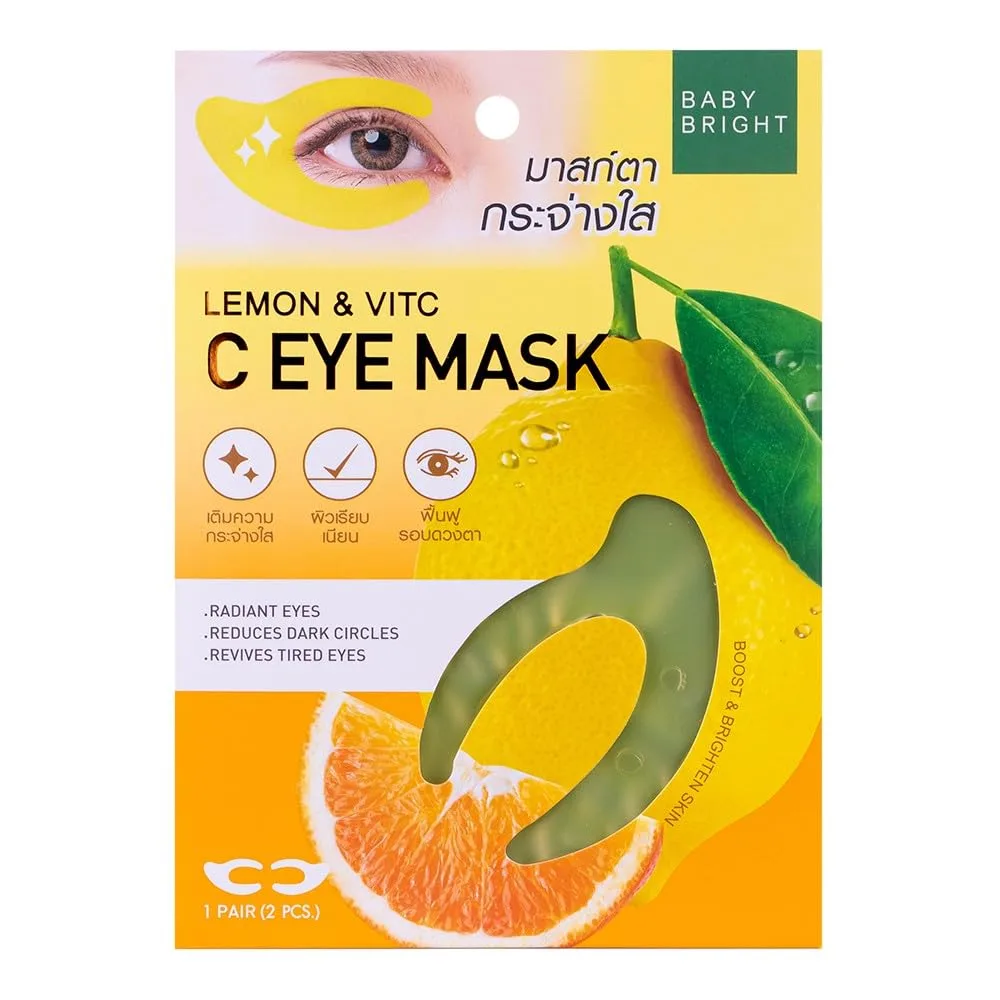
Baby Bright Lemon & Vitamin C Eye Mask
Hydrogel under-eye patches carrying vitamin C and lemon extract — the formulated version of the lemon idea, at a pH your eye area can survive.
Read the ingredient list on the pack before you buy: formulas change, and this is a cosmetic, not a treatment.
Similar products
Same idea, different formulas — so you can compare what is actually in them.
Cosmetics · Skincare
Vitamin C Under-Eye Patches
Hydrogel patches with a stabilised vitamin C. Twenty minutes of occlusion, which is mostly hydration — the vitamin C is the part that lasts.
Cosmetics · Skincare
Caffeine Under-Eye Serum
Caffeine constricts small vessels for a few hours: the honest answer to morning puffiness and the blue-ish circle, not to pigment.
Cosmetics · Skincare
Niacinamide Eye Cream
Niacinamide slows the handover of pigment to skin cells and supports the barrier — the gentlest of the brighteners, and the easiest to keep using.
Cosmetics · Skincare
Vitamin C Serum with Ferulic Acid
L-ascorbic acid kept company by vitamin E and ferulic acid, which slow its oxidation. For the face; keep it off the eyelid itself.
Cosmetics · Skincare
Hyaluronic Acid Eye Gel
Water held in the top layer, which plumps fine lines and softens the shadow they cast. It does nothing to pigment, and it is not pretending to.
Cosmetics · Skincare
Peptide Eye Cream
Signal peptides aimed at the collagen the eye area thins with age. Slow, modest, and best judged after two full months.
Cosmetics · Skincare
Retinol Eye Cream (Night)
The strongest evidence of this group for thickening thin skin — and the easiest to overdo. Alternate nights, never on the lid margin.
Cosmetics · Skincare
Cooling Under-Eye Gel Mask (Reusable)
Cold narrows vessels and moves fluid. It is the fastest thing in this list and the shortest-lived: good before a morning meeting.